Tuesday, 1 January 2013

The Versatility Of The Batman

A Batman story can be:

a detective story;
action-adventure;
science fiction, eg, alien invasion or technological innovation;
fantasy, eg, ghosts or demons;
horror, eg, vampires or serial killers;
social realism, eg, street crime or urban decay;
a psychological study of the title character or of one of his opponents;
romance, with, eg, Wayne's original fiancee, Selina Kyle or Talia;
super heroes, eg, guest starring Superman;
alternative reality fiction, eg, Gotham By Gaslight where the Batman was around at the same time as the Ripper;
humour, with, eg, the Penguin or the Riddler treated as comical rather than horrific.

It can address any age range from children looking at pictures and learning to read ("Batman is chasing the Penguin") to entirely mature content:

Selina Kyle as a prostitute with an under age partner in Batman: Year One;
a mass murder in a pornographic cinema in The Dark Knight Returns;
"Some crimes frighten even the Batman" advertising Batman: Night Cries, about child abuse.

Like many characters, the Batman has become multi-media but his two main media remain graphic novels and feature films.

Devil In The Gateway

In Lucifer, Mike Carey's imagination sustains a lengthy and dramatic story despite the near omnipotence of several of the characters. It is helpful to summarise the Luciferean narrative because its successive stages are difficult to remember after, or even sometimes while, reading them. The construction of such an intricate plot cannot have been as easy the author makes it appear.

Lucifer, retired as Lord of Hell, owns and runs the Lux night club in Los Angeles, supported by his companion, Mazikeen of the Lilim, and a human employee. An unknown agency begins granting human wishes and this process threatens to get out of control. Heaven wants neither to intervene directly nor to let the process continue. Lucifer is hired to intervene and states his price, a "letter of passage" - to be explained later (Mike Carey, Lucifer: Devil In The Gateway, New York, 2001, p. 13).

Lucifer, powerful but not omniscient, gathers intelligence by consulting various agencies. The first such is Briadach, Lord of the Lilim in exile, who, in return for some Lethe water to ease the pain of his lingering illness, informs Lucifer that the power in question surrounds a human being called Paul Begai. When Lucifer investigates, Paul, mute, immobile and confined to a wheelchair because of Rett Syndrome, has just choked to death because his sister, Rachel, wanted him to. Lucifer, examining the body, establishes, first, that someone has created a "velleity" (again, we must await an explanation) and, secondly, that, since Paul was mute, it is possible that "it" (the "velleity"?) is "...drawn to silence." (pp. 24-25).

This makes Lucifer consult Duma, former Angel of Silence. Lucifer knows that the pre-linguistic hominids created "voiceless gods," which are still sustained by prayers not addressed to any god in particular. It must be they that have woven the velleity, a wish-granting spell that is drawn to silence and that grows dangerously by accumulating power from human gratitude. Duma, although now presiding over not Silence but Hell, remains personally silent, answering Lucifer's questions only with gestures. Asked where Lucifer must go to find the voiceless gods, he points downwards. Asked how far down, he holds four fingers of his left hand horizontally in front of his downward-pointing right index finger. Lucifer understands and thanks him.

So far:

Amenadiel of the Thrones has had to negotiate on behalf of Heaven with Lucifer;
Lucifer has consulted Briadach;
he has examined Paul;
he has consulted Duma;
next, he will telephone Pharamond, a retired deity in charge of transportation;
he will also negotiate with Rachel after rescuing her from the Lilim.

Such plot developments continue to occur but I will close the current summary here. I would not have imagined that the voiceless gods of pre-linguistic hominids would be able to trouble Heaven and I would also have expected an omnipotent Heaven to deal summarily with such minor deities. However, Carey imagines a sequence of responses and counter-responses that keep the story going for hundreds of pages and that transport the reader through many interesting places en route.

The Sandman Presents

Neil Gaiman's The Sandman had two direct spin-offs:

The Dreaming, a monthly series;
The Sandman Presents, some occasional mini-series.

Mike Carey wrote three of the latter:

Lucifer;
The Furies;
Petrefax.

The Lucifer mini-series was followed by the Lucifer monthly series.

It is interesting to see what happens next to several of the characters, eg:

Charlene Mooney still works in the Inn of the Worlds' End;
Lyta Hall joins a Greek Drama group;
Lucifer creates a universe;
Petrefax has adventures in the alternative world that he entered instead of returning to the Necropolis after leaving the Worlds' End.

The stories can literally be extended indefinitely.

Sunday, 30 December 2012

Marvelman/Miracleman

Marvelman/Miracleman by Alan Moore, succeeded by Neil Gaiman, is out of print and might never be republished, let alone completed. How many people have read it or understand references to it? I am fortunate to own the entire published series, partly in monthly comic books and partly in collected editions.

There is a well known tradition of super-strong heroes, starting in mythology (Samson and Hercules), continuing through prose fiction (Hugo Danner in Gladiator by Philip Wylie) and culminating in graphic fiction (Superman, Captain Marvel, Marvelman, Miracleman). I remember from the 1950's that Mick Anglo's Marvelman, some of it recently republished by Marvel Comics, entertained the age-group that it addressed. However, it did not address adults and certainly did not reflect on the tradition that it represented.

Moore more than made up for this. Michael Moran has grown up into a world of Health Service cuts and Troubles in Northern Ireland, has married a commercial artist but not had any children, works as a free lance journalist, dreams of flying, suffers migraines and cannot remember the word from his recurrent dream. Then he reads the word "ATOMIC" backwards in a glass door....

Moore's and Gaiman's contributions, although less well known, are far more significant than anything that has been published under the titles of "Superman" or "Captain Marvel."

Saturday, 29 December 2012

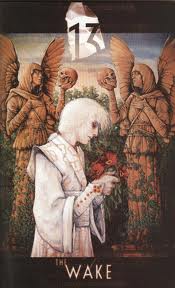
Sandman: The Wake

Can Dream be seen after he has died? Yes. He is seen in a dream. "Sunday Mourning" is a perfect conclusion to The Sandman.

To be appreciated fully, the text of "Exiles" needs to be read aloud. The desert guide says:

"I pray...Also, I hope." (Neil Gaiman, The Wake, New York, 1997, p. 126)

Because of earlier dialogues, I now see great significance in every new instance of the word "hope."

"The Tempest" is an example of what I call a "perfect" comic. That is to say:

the art, beautiful throughout, can be appreciated as such apart from the story being told;
the dialogue flows naturally and is substantial in content;
words and pictures work perfectly together.

The reader does not hurry to turn the page to follow what is being said because the attention is held by:

colourful and detailed sequential art faithfully rendering Shakespeare, his family and their contemporaries in the autumn and winter scenery of Stratford;

dramatic scenes conjured when Will reads from his work in progress;

his interview with Morpheus in the Dreaming

- a fitting celebration in a different medium of the dramatist's life.

Hope II

In an earlier post called "Hope," I summarized an exchange between Dream and a demon in which Dream trumped "entropy" with "hope." What the demon in fact said was:

"I am anti-life, the beast of judgment. I am the dark at the end of everything. The end of universes, gods, worlds... ...of everything." (Neil Gaiman, Preludes And Nocturnes, New York, 1995, p. 125)

- but I think that "entropy" summarizes this.

This theme is returned to at the end of the series. Destruction, addressing the new aspect of Dream, says:

"Entropy and optimism: the twin forces that make the universe go around." (Gaiman, The Wake, New York, 1997, p. 79)

- and Matthew the Raven, addressing the Wake, says:

" I mean, despair may be the thing that comes after hope, but there's still hope. Right? When there's no hope you might as well be dead." (The Wake, p. 80)

I said in "Hope" that I thought Gaiman had done something similar with the word "hope" in his Miracleman. He did. In the opening story, "A Prayer And Hope...," a man climbs Olympus to pray to the Miracleman. While climbing, he repeats the word "hope" - so he hopes that his prayer will be answered? In comic books, all letters are capitalized so we do not know whether he says "hope" or "Hope." On the summit of Olympus, he asks the Miracleman to save his daughter, Hope, who has been in a coma since suffering brain damage during MM's battle with his Adversary and is about to have her life support unplugged. MM refuses without explanation, the moral, drawn by another character, being that values change with perspective.

At the Carnival, the man, mentioning but not naming his now dead daughter, asks one of the permanently high "spacemen" what happens when we die. The spaceman, oracular as ever, replies:

"We are far more fair sweet sun, from the shores of my love, and it peeled out and I might touch that. Everyone's all envoys from the future too. Old friends." (Gaiman, Miracleman, No 22, Forestville, Calif. 1991, p. 14)

When asked to explain, he adds:

"Hope. What you dreamed. If they asked. You still groove with grief..." (ibid.)

- so he gives us "Hope" and a reference to dream.

The Rotating Cast Of The Sandman

Preludes And Nocturnes:
Unity Kincaid falls asleep;
Dream puts Alex Burgess to sleep;
Alex's lover is Paul McGuire;
Judy, trying to contact Donna, phones Rose Walker.

The Doll's House:
Unity, after waking, contacts her daughter, Miranda Walker, and her granddaughter, Rose;
Rose looks for her lost brother, Jed;
Lyta has been trapped in Jed's recurring dream;
Rose, lodging with Hal, meets two couples, Chantal and Zelda and Ken and Barbie.

A Game Of You:
Barbie lives in the same house in New York as Donna and a woman called Thessaly;
Donna dreams of Judy;
Barbie and Donna realise that they have both known Rose.

Brief Lives:
Dream travels in the waking world, hoping to see a young woman who left him recently.

The Kindly Ones:
Rose babysits for her neighbour, Lyta;
Hal has become the celebrity, Vixen La Bitch;
Rose visits Zelda, dying of Aids;
Rose meets Paul, who keeps vigil beside the sleeping Alex, and Lyta's lost mother;
Thessaly, the young woman who had left Dream, guards Lyta's body while Lyta's soul unites with the Furies to attack the Dreaming;
Rose and Hal attend Zelda's funeral.

The Wake:
Rose introduces Jed to Lyta at Dream's Wake.