Showing posts with label The Sandman. Show all posts

Monday, 14 April 2014

One Or Many Worlds?

Fantasy writers know modern cosmology but continue to write stories in which extra-cosmic forces seem to focus specifically on just one planet:

when Neil Gaiman's Dream of the Endless enters the waking world, it is the waking world of Earth;

in the seventeenth century, Destruction of the Endless abandoned his realm because Newtonian speculation about the inter-convertibility of light and matter was the first step towards nuclear conflict, as he knew from his experiences in many other worlds - this implies that the Endless base themselves in one world at a time;

when Mike Carey's Lucifer creates a universe, he and others from his father's universe visit only a single planet in the new universe;

when Lucifer's protege, Elaine, creates a universe, she focuses only on a single planet within it and finds even that difficult.

However:

Death of the Endless says that she is simultaneously present for the deaths of organisms on an extra-solar planet;

the single Martian living on Earth sees the Martian Dream;

Gaiman's current The Sandman prequel at last shows Dream's interstellar journey which involves extraterrestrial aspects of Dream.

Wednesday, 15 January 2014

Arthur And Merlin

I am reading JRR Tolkien's unfinished alliterative poem, The Fall Of Arthur (London, 2013), and reflecting on the continuation of the Arthurian legend into novels, films and TV series. Neil Gaiman's time traveling Tim Hunter meets the young Merlin in the past whereas CS Lewis' space traveling Elwin Ransom meets the revived Merlinus Ambrosius on Earth, then joins the undying Arthur on Venus. Gaiman's Neverwhere refers to Merlin's master, Blaise.

Tolkien wrote not a novel incorporating Arthur or Merlin but a poem in modern English though in ancient style:

                             "Time is changing;
"the West waning,  a wind rising
"in the waxing East. The world falters.
"New tides are running  in the narrow waters." (p. 32)

This rhythm recalled to my mind Gaiman's competition between Dream and Choronzon (although I am now less sure of the similarity):

Dream: I am a hunter, horse-mounted, wolf-stabbing.
Choronzon: I am a horsefly, horse-stinging, hunter-throwing. (etc)
- Neil Gaiman, The Sandman: Preludes And Nocturnes (New York, 1991), p. 123.

Thursday, 26 December 2013

Where Do Gods Go?

In Neil Gaiman's The Sandman, this question is answered in three stages.

In Volume 7, Ishtar, a retired goddess, tells Roger, the manager of Suffragette City, that gods:

begin in the Dreaming;
walk into the Land, where they are worshiped;
return to the Dreaming when they are no longer worshiped;
do not know what happens to them after that.

But the Endless know. In Volume 6, Dream tells Augustus that gods die in the Dreaming. This means that they pass from Dream's realm to that of his older sister, Death.

In Volume 2, Dream's and Death's older brother, Destiny, tells us, the readers, that gods pass from Death into non-existence although the Endless endure. Thus, we know what Ishtar and Augustus do not.

Tuesday, 24 December 2013

The Order Of Ancient Mysteries

In "In the beginning...", the Introduction to Neil Gaiman's The Sandman: The Doll's House (New York, 1995), pp. 8-11, Destiny of the Endless informs us that:

"...the Order of Ancient Mysteries...was in no wise Ancient, having been founded only sixteen years earlier..." (p. 8)

I think that Destiny of all beings ought to know better. This organization is called not the Ancient Order of Mysteries but the Order of Ancient Mysteries. It is not possible to found an Ancient Order now but it is certainly possible to found a new Order for the purpose of investigating and studying whatever Ancient Mysteries there may be.

But does Burgess conceal or deny the fact that he has founded the Order and pretend that this organization is as Ancient as the Mysteries that it studies? That would indeed be dishonesty of high degree. I think that Sandman Midnight Theatre, which I must reread, hints at this.

I met a biographer of the founder of Wicca who said, "Gardner was adept at saying things that were true but misleading." When I requested an example, I was told that Gardner asked someone to write a ritual for him, then wrote in one of his books, "Another ritual that I have heard is...," not stating but nevertheless making his readers believe that this was an ancient ritual. I think that deliberately making someone believe an untruth is lying.

Happy Christmas, everyone.

Iambic Pentameter

Marlowe: I'll stick with boys...my horned "actresses."
Shakespeare: More wine! More ale! And buss me quick, my sweet!
Sweet Kit. The play I gave you. Did you read...?
Marlowe: I must confess I have. I thought it, well...
You act well, Will, but...listen, let me read...
"Hung be the heavens with black, yield day to night!
"Comets importing change of times and states,
"Brandish your crystal tresses in the sky,
"And with them scourge the bad, revolting stars."
At least it scans. But "bad revolting stars"?
Shakespeare: It's my first play.
Marlowe:                                And it should be your last.
Shakespeare: God's wounds! If only I could write like you!
In Faustus, where you wrote...
"To God! He loves thee not! 
"The God thou servest is thine own appetite, 
"Wherein is fixed the love of Beelzebub.
"To him I'll build an altar and a church,
"And offer lukewarm blood of new-born babes."
It chills my blood!
Marlowe:             And so it should, good Will!
Shakespeare: I would give anything to have your gifts.
Or more than anything to give men dreams,
That would live on long after I am dead.
I'd bargain, like your Faustus, for that boon.
Dream: Are you Will Shaxberd?
Shakespeare:                            Aye, sir. Have we met?
Dream: We have. But men forget, in waking hours.
I heard your talk, Will. Would you write great plays?
Create new dreams to spur the minds of men?
Is that your will?
Shakespeare:   It is.
Dream:                    Then let us talk.

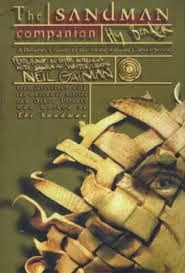
Neil Gaiman says on p. 56 of Hy Bender's The Sandman Companion (London, 1999) that he wrote this dialogue (The Sandman: The Doll's House, New York, 1995, pp. 125-127) in iambic pentameter so I have tried to transcribe it accordingly but am not sure whether I have laid out the first three lines of the quotation from Faustus correctly.

This is another parallel with Poul Anderson. Anderson's Shakespearean novel, A Midsummer Tempest, is presented as prose although much of its text is blank verse, one passage is a Shakespearean sonnet and several chapters end in rhyming couplets.                    

Monday, 23 December 2013

The Last Sandman Story

"Don't judge a book by its cover."

My copy of Dave McKean's Dust Covers (New York, 1997) has a copy of Dust Covers on its cover.

Although a good cover draws us into a book, we soon learn that the interior art of Neil Gaiman's The Sandman comic book series is not by the cover artist, McKean, but by diverse other excellent comic book artists. However, Dust Covers not only collects all of McKean's Sandman covers but also begins with "The Last Sandman Story," a new eight page comic strip written by Gaiman and drawn by McKean. Thus, in this case at least, the cover artist's recognizable style does continue beyond the cover and indeed throughout the volume.

Gaiman and McKean had agreed that this story should be "Something that had the kind of look that was of a piece with the covers." (p. 6) So, for once, we stay with the style of the cover art instead of leaving it behind as soon as we open the book.

They had also agreed to have "More prose than comics - one or two illustrations to a page." (ibid.)

pp. 6-8 and 12-13 each have two large non-sequential illustrations accompanied by substantial prose by Gaiman, not relating a new Sandman story but recounting childhood and adult experiences that had influenced the writing of The Sandman.The strip is "...anecdotal...," not "...something that extends any part of the story..." (ibid.)

I love the dust on the empty wine bottles in panel 2 of p. 6.

p. 9 shows a folded over page of an imaginary comic book with nine panels in which Gaiman, during a Hallowe'en parade in the Village, New York, converses with a man claiming to be the demon Choronzon. This is the only page with speech balloons. The meeting with Choronzon was one of the times, during the writing of The Sandman, "...when reality frayed and thinned." (p. 8)

Make of that what you can. 

A Finite Series

Standard practice with a comic that sells well is to continue selling it indefinitely through multiple changes both of creative team and of plot direction, thus generating, over time, thousands of pages of ephemeral quantity at the expense of enduring quality. When Swamp Thing  was scheduled for cancellation, Alan Moore took over the writing, reinterpreted the title character from mud monster to plant elemental and transformed the series into a top-selling title.

When Moore had finished the story that he had to tell, he gave the characters a happy ending and it is easy to stop reading at that point. His entire run has been collected and thus saved from transience. Rick Veitch continued the series well but differently. However, it had its ups and downs after that, ending on a high point with Mark Millar but revived a few times since then.

Neil Gaiman initiated a new Sandman series and insisted on it ending when he had finished the story that he had to tell. However, it has had several off-shoots, notably Mike Carey's Lucifer, also collected in its entirety, and, in any case, continues to sell better as collected editions. Because The Sandman is a lengthy but finite series, it has a comprehensible structure that can be mentally mapped:

Preludes And Nocturnes (8 issues) + The Doll's House (8) + Dream Country (4) = 20 issues;
Season Of Mists (8) + (Distant Mirrors - "Ramadan" (3)) + A Game Of You (6) + Convergence (3) = 20;
Brief Lives (9) + "Ramadan" = 10;
Worlds' End (6) + The Kindly Ones (13) + The Wake (6) = 25;
Total = 75.

Sunday, 22 December 2013

Dust Covers IV

The ten volumes of The Sandman by Neil Gaiman tell a long story in sequential graphic art. The one volume of Dust Covers by Dave McKean tells the parallel story of how McKean created fine art covers for all seventy five monthly issues of The Sandman and one Special. Each cover is displayed, often with comments by McKean, Gaiman or both. The book also includes other art, including covers of some of the ten collections.

With all this art plus the comments and the introductory comic strip written by Gaiman and drawn by McKean, Dust Covers is a substantial volume, guiding its readers through the history of a creative process.

A comic book cover usually shows the hero in action in the same kind of graphic art that is to be found within the book whereas McKean quickly dispensed with images of the central character and even with merely representational art. Not really reflecting on the covers, I had not realized that some of them had had to be constructed physically before being reproduced as cover illustrations. On the sides of the cover of no 1, ten shelves hold miscellaneous items, including a book entitled The Gates of Dawn, which is both an evocative verbal image and appropriate for a beginning. However, we could not have known, until Gaiman tells us in his first note for Dust Covers, that McKean had scrupulously erased the name of the publisher, Mills and Boon, in case it was taken to imply that The Sandman was a romance.

I took for granted that the figure on the cover of no 3 was the guest star of that issue, John Constantine, but had not known that it was also McKean's friend, Neil Jones, who had already modelled for McKean's Hellblazer covers. It is obvious that nos 14 and 16 show the Corinthian and Morpheus respectively but not, until McKean tells us, that both were modelled by Gaiman.

Scripts And Strips

Comic book scripts, or excerpts from them, make for fascinating reading on the rare occasions when they are published. The script and the strip are two material stages in the transmission of images from the writer's mind to the readers' minds. The other stages are the writer's preliminary notes and sketched mini-comic, if any, then the penciled, inked, lettered and colored art. Maybe to appreciate the creative process fully, we should sometimes see all these stages. The words for captions and speech balloons are identical between script and strip whereas the visuals can differ in detail.

Neil Gaiman's The Sandman: Dream Country (New York, 1995) collects four stories and the script for the first, "Calliope". Page 1, panel 2, shows Richard Madoc's study which, according to the script, contains bookshelves, desk, word processor, encyclopedias, maybe paintings, occasional small statues, an exterior door and "...a slim telephone on a table in one corner..." (p. 119 of the book; p. 2 of the script).

Since a comics script is also a letter of instruction to the artist, in this case Kelley Jones, Gaiman adds that all these details need not appear in this one panel:

"...DROP IT IN AS WE MOVE AROUND THE ROOM, LOOKING AT THESE PEOPLE." (ibid.)

Thus, here is an imaginary space, Madoc's study, initially existing only in Gaiman's mind. Gaiman not only describes this space to Jones but also advises him how to introduce it to Sandman readers. This introductory panel shows bookshelves, desk and word processor. The door and the telephone, not particularly "slim," appear in panel 4 of page 2. The study location is in several panels but many of these are close-ups on the characters not showing any background details.

A single comparatively minor space requires this amount of attention to detail although, of course, it is just one of many imaginary spaces, also including the interiors of Morpheus' castle, the Inn of the Worlds' End and a sailing ship.

The first exterior shot in "Calliope" is page 3, panel 4. Gaiman describes a London street, says that he will send photoreference and adds:

"I DOUBT THAT WE CAN SILHOUETTE HIM AGAINST THE SKYLINE, UNLESS HE'S ACTUALLY WALKING BESIDE THE THAMES HERE..." (p. 122/5)

In the comic, he is walking beside the Thames. It is extremely instructive to look back and forth between script and strip, checking for differences, but we would not be able to do this or to benefit from it on every occasion of reading a comic.

Saturday, 21 December 2013

"...And There Is Death"

Superman began in 1938, Sandman in 1939, both during the Golden Age of Comics. That original Sandman was a vigilante like the Batman but was also part of the new superheroes genre initiated by Superman. Over that many decades, comic book characters appear in several versions.

Superman's comic book versions have been those associated with, in this order:

Earth 2;
Earth 1;
Earth DC/ "Man of Steel" miniseries;
"Birthright" miniseries;
the 52 multiverse;
the New 52 multiverse.

I think. I may have got it slightly wrong towards the end but you might detect my lack of interest in too many continuity changes happening too quickly for any sort of narrative continuity or plausibility.

The Sandman versions have been:

the Golden Age version;
Jack Kirby's different version of the 1970's;
Neil Gaiman's re-creation of the Kirby version in which the title, The Sandman, and the central character's names, Morpheus, Dream etc, diverge.

The Superman of Earth DC indirectly influenced Morpheus because that Superman's powers had been scaled down for plausibility whereas Gaiman, disagreeing with this, decided to make his Endless, including Dream, virtually omnipotent. I agree with DC that it was inappropriate that Superman, a physical being, had become infinitely fast, strong etc but I also fully accept Gaiman's different treatment of his metaphysical Endless.

A fact of life is that we all die permanently. A fact of comic book life is that central characters die temporarily. Monthly comic books overdo and cheapen everything, even the death and resurrection myth. In one Green Arrow comic, the regular return of the deceased had become such a routine occurrence that they even asked the embarrassing question, "How many of you were at my funeral?"

The Superman of the DC universe died in 1993 and Neil Gaiman's Morpheus/Dream died in 1995 but what a difference! Superman stayed dead or, later, presumed dead for most of '94 but then was back to normal with a complete loss of story direction whereas Morpheus stayed dead and his series ended but is permanently in print in collected editions. Thus, he is of much more enduring significance than any character who merely recurs in different versions in ephemeral monthly periodicals. There was a new Dream at the end of The Sandman but this was a new aspect, a different personality, with no memory of having been Morpheus who had permanently and irrevocably entered his sister's realm.

Imagine a version of Superman treated as seriously as Gaiman treated Morpheus. See my earlier post "Getting Superman Right."

Dust Covers

I have mislaid my copy of Dave McKean's Dust Covers, the annotated Sandman covers with a new comic strip by Gaiman and McKean. I have come to accept that not being able to find a book when I want to refer to it is a regular part of the deal with books and has to be accepted as such. Longer term, if it never turns up, I can buy another copy.

(Over a very long period, I visited friends regularly, left all my Sandmans to reread, and for them to read, at their place and wound up buying new copies to have at home - but they had been reread so often that I felt that the author deserved a second set of royalties.)

We make literary references by citing author, title, place and year of publication and page number as if every published text was eternally present in a universally accessible Platonic realm whereas, in reality, the ability to make or check the reference is entirely dependent on access to a physical copy of the book.

From memory, then, I think that the comic strip in Dust Covers covers:

the author seeing the Sandman - in reality the Moon and a tree with an outstretched branch - pouring dust onto his daughter's face as she lay in bed;
the Death girl seen by McKean on a plane where a passanger died;
Alan Moore seeing John Constantine in a London sandwich bar;
Death serving in a New York cafe - as opposed to Death serving in a London restaurant;
Choronzon the demon telling Gaiman that he does not understand any of this.

Choronzon is right to the extent that writers and artists do not fully understand the creative process.

(Interrupted by the obligation to deliver Christmas presents to children. To be continued later.)

Friday, 20 December 2013

Seventy Two Years

In Neil Gaiman's The Sandman, how long was Morpheus imprisoned? Gaiman gives a precise answer:

"...seventy-two years - ending in late 1988, when the series debuted."

- Hy Bender, The Sandman Companion (London, 1999), p. 235.

There is a hint of meta-fiction here. December 1988 is both when Gaiman's monthly Sandman comic book began publication and also when Morpheus resumed his activity in the world after a long, enforced absence. That absence is said to have begun in 1916 because Gaiman had decided that it was Morpheus' imprisonment that had caused the otherwise unexplained "sleepy sickness" that began in that year. It is strange, when reading about the unquestionably fantasy event of Morpheus' imprisonment, to be told that it is having observable effects in the public world of the Great War but it turns out that these "effects" are real, recorded events.

Morpheus' long absence explains why readers of DC universe continuity stories, which began to be recounted in 1935, have not heard of him before although they have encountered those inhabitants of his realm who previously hosted various horror titles. Thus, Gaiman retroactively makes his new series compatible with all the others, importantly including Alan Moore's Swamp Thing, which had recently revived Cain and Abel of the Houses of Mystery and Secrets.

Cain and Abel had hosted their Houses;
the Three Witches had hosted The Witching Hour;
Lucien had hosted Tales Of Ghost Castle;
a woman with a raven hosted Dark Mansion Of Forbidden Love;
Eve with a raven had appeared in Secrets Of Sinister House and Secrets Of Haunted House.

Thus, there were altogether four Houses (Mystery, Secrets, Sinister and Haunted, the latter two also with Secrets), one Castle (Ghost) and one Mansion (Dark). The Castle became Morpheus' while the women with ravens merged and retired to a cave. The Mystery and Secrets Houses remained in the Dreaming as way stations to Nightmare.

Having just reread the entire series, I am sure, without looking them all up, that I came across dialogue references to Morpheus having been imprisoned for sixty, seventy and eighty years, but this makes sense. People in conversation do not remember precise details and think in terms of round numbers. It would be very inauthentic dialogue in which every single person who referred to the lengthy imprisonment exactly remembered the precise figure of "seventy two years."

Probably many apparent inconsistencies in works of fiction can be ironed out if it is remembered that, even when they are not placed between inverted commas or inside speech balloons, most statements express a single character's point of view which is bound to differ from other povs. Thus, a medieval character in a historical novel by James Blish is said to "know" that comets are phenomena in the upper atmosphere. However, a contemporary novel and a futuristic sf novel complete the trilogy but their characters would not be said to "know" that about comets.

I am confident that Gaiman would deliberately write inconsistencies in his dialogues. In Worlds' End, he has the handsome cabin boy misquote a poem.

Personal Observations II

More autobiography, which will again be relevant.

In 1988, I had academic qualifications in Philosophy and Religious Studies but not yet any professional training. The headmaster of an independent school mistook Religious Studies (study of religions) for Theology (knowledge of the Bible) and did not ask the right questions in my job interview so I became Master in Charge of Religious Education, fortunately a part-time post, and had to work full time reading Biblical texts and commentaries. (I learned a lot; no one else did.)

I would not have lied in the interview and should not have been appointed. I also lacked a teacher training qualification but the school, wrongly, did not require that. When I met the man whom I was to succeed, a vicar, he mentioned the Good News Bible, adding "...with which, of course, you are familiar." I had to say, "Yes." By that stage, it had become my responsibility to learn about the Good News Bible, and indeed the Bible, as quickly as possible.

A year later, I had been laid off. The stated reason and a real reason was the school's financial difficulties. Religious Education had to be shared among the other staff. Deciding to build on that year's experience by gaining a teaching qualification, I attended a postgraduate course where a fellow student said, "I've heard that, although the Good News is not an accurate translation, it is good if you just want the story," to which I replied, on the basis of a year's experience of working with that text, "Yes, the Good News is very readable!" So, by then, I had justified my saying "Yes" to the vicar.

Relevance to Neil Gaiman: to gain work as a journalist, Gaiman phoned magazine editors and claimed to have worked for Time Out, City Limits, The Observer and The Sunday Times of London Magazine.

"NG: ...over the next five years, I  actually did write for every magazine I'd mentioned during that first week of cold calls. So I wasn't really lying, I was merely being anachronistic. [Laughter.]"

- Hy Bender, The Sandman Companion (London, 1999), p. 14.

Gaiman knew that, by pitching good ideas, then writing well, he was making it very unlikely that any editor would ever check up. Good for him. I would not have imagined that it would be possible to get away with that and, in any case, would not have felt right about doing it. But my writing style is not journalistic so I would not have been looking for that kind of work in the first place. I felt that the lie to the vicar was forced upon me and did my best to be, as Gaiman puts it, "...anachronistic."

In a later job, a new Human Resources Manager pressurized me to resign, then got me charged with serious misconduct. With support from colleagues and trade union members, I withstood this attack and remained in the job. After the HR man had dissatisfied his superior a few times, he was asked to produce the management qualification that he had claimed in his application and was summarily dismissed when he was unable to comply. Extraordinary.

Personal Observations I

Please bear with some autobiography. I will explain its relevance.

In 1988-'89, I retrained as a Careers Officer, then worked continuously from 1989 until retirement in 2012, although job title, job description and nature of employing organization changed more than once as governments responded to rapid socioeconomic changes.

One of our trainers told us a true story and cautionary tale. A client had said, "I want to start a pop group and make a record and I want it to go to No 1 in the charts." Her Careers Officer replied, "You have no chance." She did it. One of my fellow trainees recognized the name of the group. That Careers Officer then told that story as a warning to others. Never let it be said that we do not learn.

I never told anyone that they could not do anything. When a guy said that he wanted to be a musician, I:

asked him about his existing involvement with music, if any;
provided printed careers information on "Musician";
highlighted the requirements of the job;
pointed out that music can remain a leisure interest and activity even if it never becomes a source of income;
strongly advised the formulation of a Career Plan B and discussed what that might be (all advice was written and recorded; I could never be accused later of telling someone that he could (or could not) be a musician).

Despite this, I discovered that, without my knowledge at the time, I had been criticized for not telling a pupil that he could not be a musician, even though this was in a school where a teacher had been told by one of her teachers that she could not teach because she was Dyslexic and had set out, successfully, to prove him wrong.

The relevance of this to Neil Gaiman:

"'When the [careers] advisor asked me what I wanted to do, I didn't hesitate, because I'd been waiting to tell the appropriate person for years,' says Gaiman. 'So I answered, "I want to write American comic books." And what I wanted him to say was, "Okay, that is a commendable ambition. You should go to the School of Visual Arts in New York, and you should work on your craft, and these are the people with whom you should talk to get you on your way."
"'Instead, he just replied, "Oh, you can't do that. Have you ever considered accountancy?"'"

- Hy Bender, The Sandman Companion (London, 1999), p. 13.

I could not believe that! That advisor needed to:

ask Gaiman about his writing abilities;
advise him to try every kind of fiction publishing;
ask him how much he already knew about American comics publishers;
promise to get him more information about them;
not mention accountancy.

One of my clients said that he wanted to draw American comics. I asked, "Will you be the next John Byrne?" He was puzzled, not because he did not know the name "John Byrne" but because he did not expect it in that context. We soon established that I had Byrne's Man Of Steel miniseries in the monthly comics whereas he had had to buy the collected edition. When I met him in a comics shop a few years later, he was by then attending Art College.

Thursday, 19 December 2013

The Sandman Mega-Series

10 vol original series
  2 Death series
  2 collections:
     Endless Nights
     Midnight Days
  2 versions of The Dream Hunters
  4 related works:
     Black Orchid
     The Books Of Magic
     The Children's Crusade
     Stardust
20 vols total

(Stardust mentions Death once. She should have appeared in the film.)

The main narrative of Dream, beginning with his imprisonment and ending with his death, is recounted in six volumes, divided into three pairs:

Preludes And Nocturnes
The Doll's House

Season Of Mists
The Game Of You

Brief Lives
The Kindly Ones

The remaining four volumes of the original series, divided into two pairs:

Dream Country
Fables And Reflections

Worlds' End
The Wake

move the characters in many different directions, which is what Gaiman wanted to do with the series.

Sunday, 15 December 2013

Ishtar And Destruction

In Neil Gaiman's The Sandman: Brief Lives (New York, 1994), Chapter 5, p. 20, Ishtar says that gods:

start as dreams;
walk into the land;
are worshiped and loved;
take power;
when they are no longer worshiped, return to dreams;
do not know what comes after.

Elsewhere in The Sandman, it is said that gods no longer worshiped go from Dream to Death to non-existence.

In Chapter 8, on p. 16, Ishtar's former lover, Destruction of the Endless, says that the Endless, whom we know to be anthropomorphic personifications of aspects of consciousness, are:

patterns;
ideas;
wave functions;
repeating motifs;
echoes of darkness;
nothing more.

Death told Destruction that everyone knows everything but pretends not to. Delirium comments:

"She is. Um. Right. Kind of. Not knowing everything is all that makes it okay, sometimes." (Chapter 8, p. 15)

One of my school teachers was, in some ways, rather obtuse but did make one wise statement, that if, at the beginning of life, we were given a preview of all that was ahead of us, we would not be able to face it.

Delirium insists that she knows things that even Destiny does not, including why she stopped being Delight (Chapter 7, p. 11).

Saturday, 14 December 2013

Temple Prostitution

Another parallel between the works of Poul Anderson and Neil Gaiman is temple prostitution.

In Anderson's "Ivory and Apes and Peacocks", Manse Everard of the Time Patrol, gathering intelligence in King Hiram's Tyre, gains the gratitude of Sarai, a well-connected member of the palace staff, by freeing her in the temple.

In Gaiman's The Sandman: Brief Lives (New York, 1994), an exotic dancer called Nancy, with a Masters in Women's Studies, explains to fellow dancers, Tiffany and Ishtar:

"The Near East, right? Two, three thousand years ago, one of the love goddesses...Astarte, maybe [Everard's is Asherat]. Every woman in that country had to go to the temple, once in her life. All the women waited in the temple courtyard. Each one had to wait there until a stranger offered her a coin. Whoever he was, she had to go with him, and they'd make out. I think there were rooms in the temple to do it in [Everard and Sarai had to go elsewhere]...The historian made some sexist crack about the women. Because they couldn't leave until someone made love to them. He said the good-looking ones got off early, but the rougher-looking ones sometimes waited in the temple courtyard for months. But that's history for you, all written by men [and that had been Sarai's fate]." (Chapter 5, pp. 11-12)

Nancy and the others then wonder what happens to goddesses Who are no longer worshiped. Do some become exotic dancers? Because The Sandman is a fantasy, we soon learn that the dancer Ishtar is indeed the goddess, a revelation that could very readily have fitted into one of Poul Anderson's fantasies.

Reason And Destruction

I think that the missing member of the Endless is first named when Despair says, "...my Lord of Destruction..." on p. 22 of Chapter 1 of Neil Gaiman's The Sandman, Volume 7, Brief Lives (New York, 1994).

Later, Destruction tells Dream, "Times are changing...They are using reason as a tool...It is no more reliable a tool than instinct, myth or dream. But it has the potential to be far more dangerous..." (Chapter 4, pp. 18-19).

To stay with instinct would have been to stay with animality. Destruction, an anthropomorphic personification of an aspect of consciousness, thinks that we need tools only for living, dying and, in his case, destroying. However, reason is a better tool than myth or dream for learning. At least some of us value knowledge of the planet Mars while still appreciating myths of the god Mars.

I did speak to someone who did not see knowledge of modern scientific cosmology as preferable to continued belief in Buddhist cosmology as literally true. We can demonstrate practical applications of science and unexpected outcomes of research but I also see pure knowledge as a value in itself. When Sherlock Holmes said that he did not care whether the Earth went round the Sun or vice versa, I disagreed with him. (In fact, I was appalled.)

Dream says that reason will not affect his domain and will do little to Destruction's but Destruction does not relish scientific warfare because he has seen it before. Although the Endless are cosmic principles, they for some reason base themselves in one world at a time and are currently on Earth.

Dream comments:

"...they are cutting up apes?...Do they think that they can impale the soul of it on their knives? That if they cut deep enough they can extract its dreams, naked and writhing and screaming, from its head? Reason is a flawed tool at best..." (Chapter 4, p. 20)

We need to observe and experiment to find out what we can find out. Reason is not an all purposes tool but that does not make it flawed.

Thursday, 12 December 2013

Sandman: Miscellaneous

(i) "And they came with [the wind], scurrying and skittering, like yellow leaves and old newspapers, from a thousand places and from none at all."

- Neil Gaiman, The Sandman: The Doll's House (New York, 1995), p. 140.

Comment: style-wise, Bradburyesque?

(ii) "Living Bodies" (earlier post) revisited: in The Sandman: A Game Of You (New York, 1993), Barbie's body lies unconscious while Barbie herself, her soul, is in her dreamworld, the Land, but when three other women travel the Moon's road to join her there, their bodies disappear from the apartment room in New York.

So, in the Dreaming, we see her soul but their bodies but no one seems to be aware of this? A similar situation occurs when two of the women meet Death in the second Death miniseries. I think that the metaphysics becomes a bit confused at these points.

Monday, 9 December 2013

One Long Story

When does the Sandman story begin and end?

(i) In the prologue to Volume 2, but in prehistory, Morpheus condemns Nada to Hell.

(ii) Before Volume 1, he is weakened by a mission to another world. (The story of that mission is being recounted in a current series.)

(iii) In Volume 1, he is imprisoned and his tools stolen but, by the end of the volume, he has escaped and recovered the tools.

(iv) By the end of Volume 2, he has recovered the four arcana who had escaped from his realm in his absence but has also begun to interact with Lyta Hall and her son, Daniel.

(v) By the end of Volume 4, he has freed Nada.

(vi) By the end of Volume 7, he has killed his son, Orpheus.

(vii) In Volume 9, his killing of his son enables Lyta to unleash the Furies, which leads to the replacement of Morpheus by Daniel.

I have skipped over several important details here but this is a brief attempt to locate a beginning, an ending and the path between them.